 By realmnova
According to Bloomberg, United States President Trump has officially signed the National Stabilisation Currency Innovation Introduction Bill (known as the Genius Act), a groundbreaking development that marks the first time that the United States has enacted a major special law with a encryption currency at its core. It is worth mentioning that, with the signing of the bill, the global virtual currency market has reached a $4 trillion milestone.
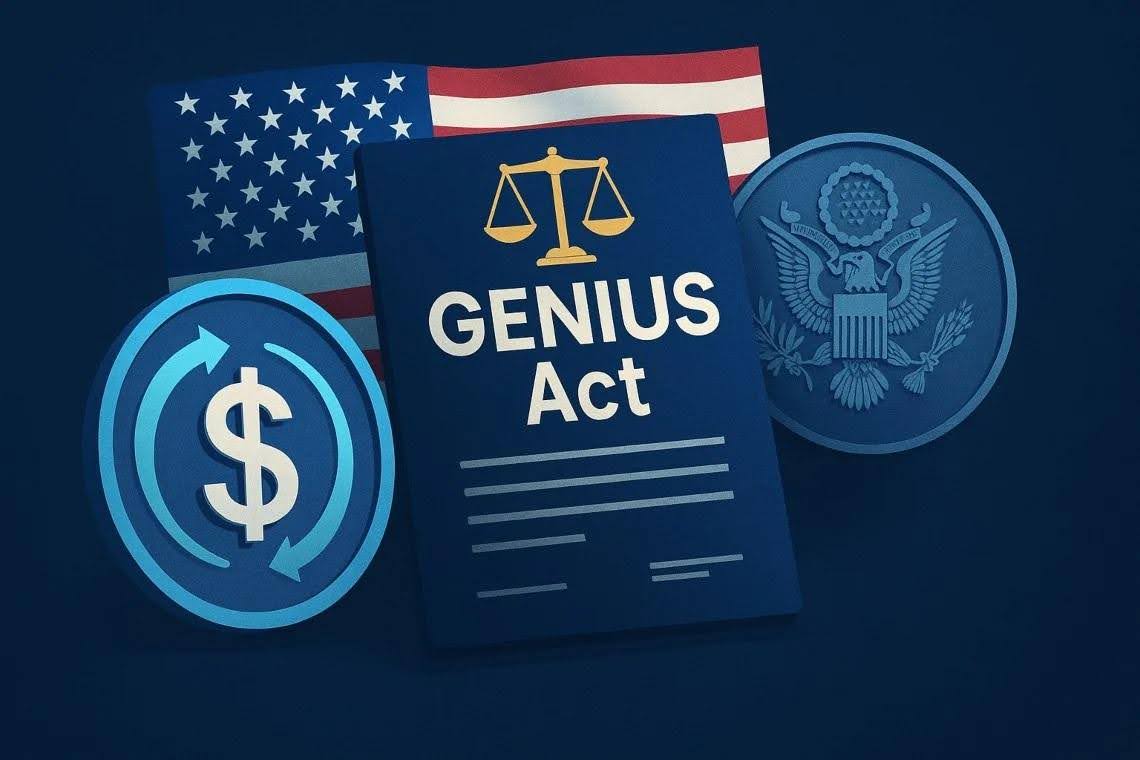
Earlier this week, the adoption of the bill had a bump. Some members of the United States House of Representatives have challenged the bill, arguing that it contains obvious loopholes, including the failure to adequately safeguard the user ‘ s right to self-cussion of encrypted assets, and the failure to really exclude the possibility of a central bank digital currency. To counter resistance, Trump invited dissenting parliamentarians to consult and eventually succeeded in securing 11 of the 12 additional supporting votes required to ensure the passage of the bill. The Genius Act establishes a comprehensive framework for the stabilization of currencies by requiring that all dollar-linked stable currencies be fully supported at a ratio of 1:1 per cent of eligible reserve assets (mainly the United States Treasury debt composition); requiring regular reserve audits by the issuer of the stable currency and monthly public disclosure of relevant information; allowing banks and other eligible entities to issue stable currencies free of onerous requirements under the securities law; and compliance by all issuers with anti-money-laundering legislation, including know-your-client rules.

Under this framework, there is a dual licensing system for the issuance of stabilization currency. The issuer must obtain a federal or state licence to operate, which may be issued by the monetary supervisor under the United States Treasury Department. Small issuers with a market value of less than $10 billion may choose to apply for a state-level or federal licence, while large issuers must obtain a federal licence and regulatory bodies must decide on a licence application within 120 days. Applicants are required to demonstrate that they have sufficient capital funds, 1:1 high-quality liquidity reserves, robust internal control mechanisms and anti-money-laundering compliance capacity.The bill is expected to boost a stable currency market linked to the United States.The total market for industry addresses is expected to grow from about $240 billion today to $75 billion by the end of 2026. The biggest “loser” of the bill is Tether, a foreign issuer. The USDT stabilization currency will not be legally in circulation in the United States. Non-compliance stabilizers must exit the market within three years. However, Tether can maintain its presence in the United States by establishing new subsidiaries in the United States or working with licensed issuers. It is worth noting that Howard Lutnick, former Chairman of the Cantor Fitzgerald Investment Bank, Tether ‘ s main supporter, is the current United States Treasury Secretary, which provides some room for Tether ‘ s good offices for the future.

The threshold for large technology companies to issue their exclusive stabilization currency is very high, with the unanimous approval of the “Stabilization Currency Certification Board” composed of the Minister of Finance, the Chairman/Vice-Chairman of the Federal Reserve and the Chairman of the Federal Deposit Insurance Corporation. Two other important bills were passed by the House of Representatives during the legislative campaign known as the “encrypted week”. The Anti-CBDC Act explicitly prohibits the United States from issuing a Central Bank digital currency (CBDC); the Clarity Act formally delineates the regulatory jurisdiction of the United States Securities and Exchange Commission and the Commodity Futures Trading Commission in the area of encrypted currency and establishes a consumer protection framework. The two bills have been submitted to the Senate for consideration. At the same time, BlackRock, the head of the Asset Management Authority, has recently shown a clear preference for Bitcoin, which may herald a new wave of currency.

The signing of the Genius Act, a watershed event in the history of encrypted monetary regulation in the United States, establishes rules at the national level for the key area of currency stabilization and will have far-reaching implications for the future patterns of encrypted markets and the position of the United States in the field of digital assets.